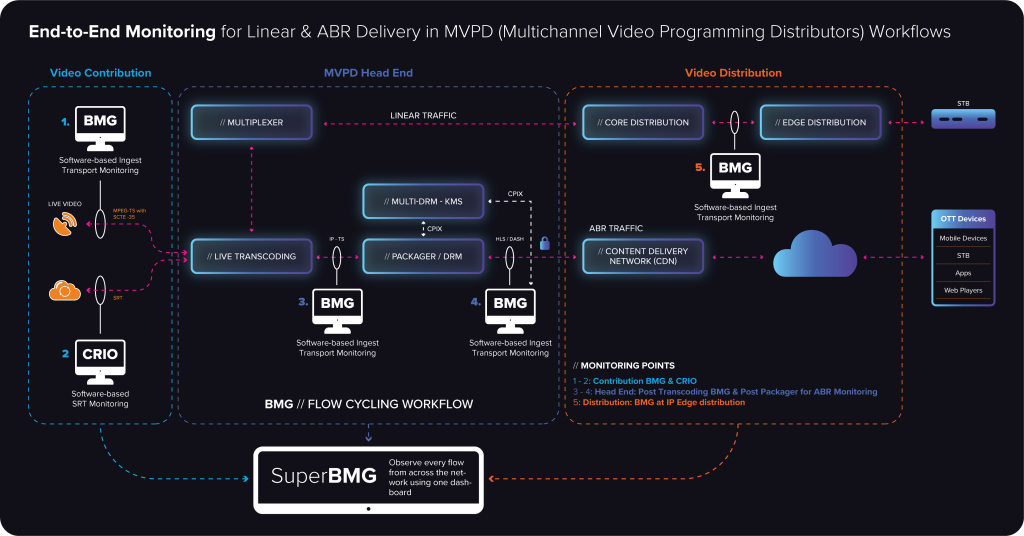
Linear and ABR content delivery in MVPDs (Multichannel Video Programming Distributors) relies on diverse network architectures. Whether the contribution path uses satellite links or SRT (Secure Reliable Transport) and is distributed through IPTV or OTT, every piece of the chain must operate seamlessly to ensure a consistent, high-quality viewing experience.
Once content enters the facility, it travels through an ecosystem of transcoders, packagers/multiplexers, and IP switching equipment before finally making its way out to subscribers via IP or RF distribution. Along this journey, failures can occur at any point, typically falling into two major categories:
Equipment-Related Issues
IRDs, transcoders, and packagers/multiplexers can behave unpredictably or fail outright, resulting in video or audio artifacts that appear and disappear without warning.
Network-Related Issues
Even when hardware is functioning correctly, the network path between components can be the trouble spot. Packet loss, jitter or congestion can all introduce intermittent impairments that are difficult to trace.
Intermittent problems can be especially frustrating, as they may appear only for a few seconds or affect only certain services. Accurate, timely detection and correlation of these issues are critical. Operators need to quickly understand what failed, where it failed, and why it happened.
Effective monitoring relies on strategically placed test points throughout the headend:
- At video contribution: validating the quality and integrity of incoming services. Content often arrives via satellite receivers or SRT contribution feeds, so identifying issues such as transport errors, packet loss, or jitter is crucial.
- Within the facility: where routing and stream processing are performed.
- At distribution: Verifying the output at the delivery point to ensure it matches expectations.
How can faults be isolated?
One of the most significant challenges in multi-vendor video delivery environments is ensuring seamless integration and operation of all components. Equally important is providing engineering and video operations teams complete visibility into the health of the video service throughout the contribution, processing, and distribution chain.
For video service providers, the ability to quickly pinpoint where a problem occurs in the network is essential for maintaining a high-quality experience. Providius offers a suite of tools designed to isolate faults, whether related to equipment or the network, at multiple points along the distribution chain. This allows MVPDs to accurately determine the source of an issue and work proactively with vendors and internal teams to resolve it, clearly defining demarcation points and responsibilities during troubleshooting.
With solutions like Broadcast Media Guard (BMG), CRIO (Capture, Record, Inspect, Observe), and, in some deployments, Super BMG, service providers can access real-time analysis and fault reporting, with detailed error detection at each monitoring point. This comprehensive visibility allows operators to address technical issues before they affect end users, reducing downtime and improving service availability.
In this series, we’ll explore how measurements can be made at key test points and discuss the critical metrics to monitor, including:
- SRT Video Contribution
- Monitoring Contribution and Transcoding Outputs: TR 101 290, stream bitrate, closed caption, black, frozen, and video loss, packet telemetry
- Audio
- SCTE-35 Verification
- OTT Distribution
Monitoring solutions like BMG and CRIO empower operators to validate service quality across the entire workflow from SRT contribution through linear transcoding to ABR packaging and delivery. By correlating data from multiple points, teams can quickly determine whether issues arise from equipment failures or network transport, dramatically reducing MTTR and minimizing viewer impact.